Records form part of your arrangements

Communicate wisely – Health and Safety investigations dig deep

Keep your communications professional and make sure you know where they are stored. Useful tips if you are ever on the sharp end of an investigation by the Health and Safety Executive (HSE). 

Section 20 of the Health and Safety at Work act 1974 gives the HSE the power to “require any person to produce any books or documents… which are necessary for you to see for the purposes of your investigation”. 

This seems entirely reasonable if there has been an accident or incident worthy of an investigation, and indeed should be welcomed, not least for valuable lessons learnt. But, as an employer or employee, have you ever considered exactly what documents the HSE might be requiring from you, and have you thought how and where they should be stored so that you can comply easily with an inspector’s request? 

Most employers are aware where they store their Health and Safety policy, risk assessments and minutes of meetings such as safety forums or committees. But do you know where your WhatsApp safety chat is stored and uploaded? Could you put your hands on that memo on the intranet that updated the latest safety data sheet? 
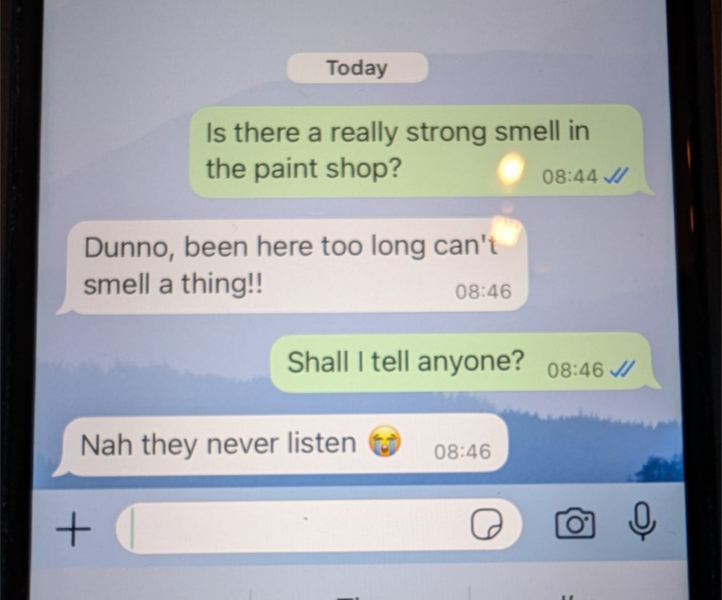
More importantly, do you have good knowledge of any communication between your employees on Health and Safety issues which may be informally recorded in texts or emails without any consideration being given to them being read in “hindsight”.

Our basic advice is:  

  • Keep essential Health and Safety documents in one, easily accessed place, whether physically or online 
  • Be aware that your documents and communications may be subject of inspection and keep them current. 
  • Make sure you are actually doing what your documents say you do – if not, change your actions or the documents…  
  • Ensure your workforce are aware that their communications could one day be looked at by an external body and remind them to think before communicating and keep it strictly professional. Don’t forget that can include texts, chats, emails and social media posts. 

 For help and advice on any of your Health and Safety issues contact us. 

Beat the statistics, nurture your work force

Nearly one million workers in Britain suffer from stress, depression, and anxiety.

These are the latest statistics from the Health and Safety Executive (HSE). The figures from the workplace regulator show there were an estimated 914,000 cases of work-related stress, depression, or anxiety in 2021/22 and an estimated 17 million working days lost.

DO SOMETHING NOW

More than ever employers need to ensure that there are up to date arrangements in place to support their employees’ well-being.

JUST THE LATEST FAD!

It’s been a tough few years and mental health seems to be the latest “buzz” word. It’s tempting to ignore it and hope it goes away.

For small businesses making new arrangements around mental health may seem onerous and a little “new age”. However it is not only the “right” thing to do, morally and legally, it actually makes good business sense.

A recent survey from Deloitte suggests the total annual cost of poor mental health to employers has increased by 25% since 2019, costing UK employers up to £56 billion a year. Deloitte’s findings also suggest that UK bosses will receive an average return of £5 for every £1 spent on mental health.

GOOD NEWS

The good news is there are some great resources to help employers comply with their legal duties around mental health.

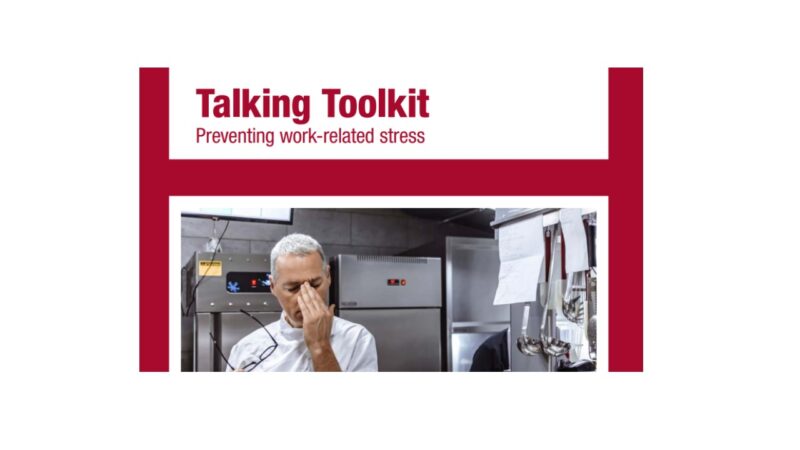
The HSE has created a Talking Toolkit to assist employers in speaking to their employees and taking the important first step towards preventing work-related stress and developing the actions and stress risk assessment employers need to comply with the law.

Talking Toolkit: Preventing work-related stress (hse.gov.uk)

By law employers need to assess the risk of work-related stress and to put steps in place to tackle those risks. This can also reduce sickness absence, boost morale and therefore help improve productivity.

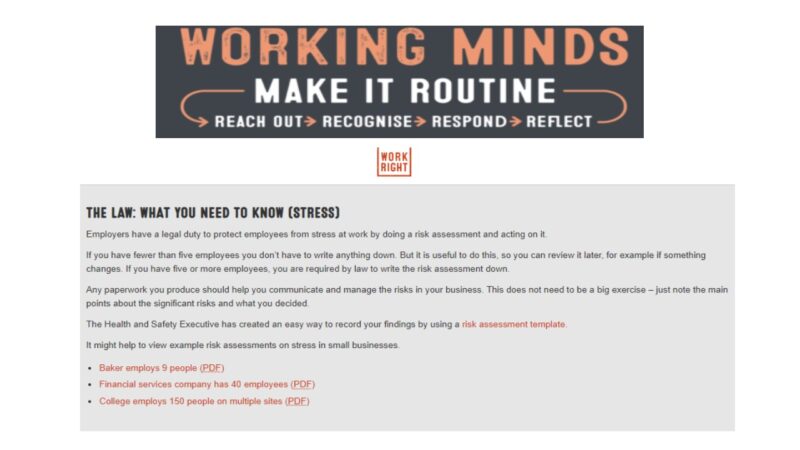
Work Right is a campaign by the Health & Safety Executive aimed at helping smaller businesses and workers. The Working Minds section offers a range of tools and support to help businesses and workers understand the best ways to prevent work related stress and encourage good mental health. Check out the helpful sample risk assessments. Click below:

Simple steps can make a huge difference to someone’s working life, and we spend a huge proportion of our lives at work…

Work equipment markings

Following BREXIT … the requirements for placing work equipment and machinery on the UK and EU markets, including arrangements for conformity assessment, marking and labelling have changed.

Only safe and compliant products should be placed on the market. Changes made to the UK’s legal product safety framework will allow it to remain operable.

CE marked goods on the GB market

CE marked workplace products will be accepted in GB until 31st December 2022. This includes workplace goods which have been assessed by an EU-recognised notified body.

GOV.UK – Placing manufactured goods on the market in Great Britain.

Placing products for use at work on the GB market: a product safety guide (PDF) .

The new UK mark

The UK Conformity Assessed (UKCA) mark is the new UK product mark for workplace products and other goods. From 1 January 2021 UKCA marking began to replace CE marking for goods being placed on the GB market.

From 1 January 2023 you must use the UKCA mark on all workplace goods products.

Return to Work under COVID-19

All UK businesses have been impacted by the coronavirus pandemic and this has forced many to close while the Stay at Home campaign is in place.  If your company is fortunate enough to consider a return to work soon then, SoPro Safety has compiled a free checklist which may be useful.

We have published this aid to restarting a closed business to help you consider some of the arrangements that the ‘different normal’ may impose on us for the future such as social distancing in the workplace.  Hopefully it will nudge you to review the topics you need to work through to keep colleagues and customers healthy and safe.

Those who require tailored support in these difficult times only need to ask us for further guidance to help the transition from closed and furloughed to a steady and safe re-opening of the business.

You can receive this by completing the form on this page.

Contact us if you are looking for assistance.

Health and Safety Statistics

Key figures for Great Britain (2017/18)

The statistics for 2017-8 can be downloaded from the HSE website and make interesting reading.

Of course by taking reasonable steps to comply with legislation and your moral duties your business need not form part of these costly statistics and flourish as a safe effective and efficient business.

Contact us for advice and guidance to help you comply.

2017 – 18 RIDDOR Headline figures

Information from the Health and Safety Executive recently.

144 Workers killed in 2017/18 (RIDDOR)

Fatal injuries to workers by main industry

Amount of fatal injuries to workers divided by age

Main kinds of fatal accident for workers

Rate of fatal injury per 100,000 workers

Rate of fatal injury per 100,000 workers

In addition, 100 members of the public were killed due to work related activities in 2017/18

HSE myth busters

An extract from the Health and Safety Executive’s (HSE) website:

Do you need to wear safety footwear all the time?

An employee questions the need to wear safety footwear for the whole of their shift as they think their work does not always warrant it.safety boots

HSE Panel decision

Health and safety law only requires safety footwear to be worn where there is a real risk of injury. It is not uncommon for employers to adopt a policy requiring the wearing of safety footwear at all times, when and where there is a risk that people would not change into and out of PPE footwear during the day. We would recommend that employers and employees discuss what is really required in this case. It may be that the risks are such that sensible shoes are a preferable alternative to requiring full PPE footwear to be worn for a full 8 hour shift.

UK safety fines rose 80%

… according to Health and Safety Executive’s (HSE) injury and ill health statistics

A scary headline to make any boss take a long, hard look at Health and Safety arrangements in their company or organisation…

In 2016-17 – the first full year that the new sentencing guidelines for safety and health offences were in place – fines reached £69.9m compared with £38.8m for the same period a year earlier.

But it’s not all bad news. Whilst the fines handed to dutyholders found guilty of safety and health offences increased by 80% in the 12 months to the end of March 2017 there was a fall in the number of cases prosecuted.

Under the new guidelines, the level of fine corresponds to the offending organisation’s turnover. If convicted of a safety and health offence, large organisations that turn over more than £50m and fall into the “very high” culpability category could be fined up to £10m.

The HSE and local authorities also issued 11,913 enforcement notices in 2016-17, a 5% increase compared with the previous period when 11,380 were served.

It’s really good to see the number of cases prosecuted falling but we continue to urge everyone to make sure they avoid complacency in the workplace.

We are always happy to arrange an “anti-complacency” visit to your business or organisation, working with you to ensure all of your Health and Safety arrangements are in place and, more importantly, are working…

New regulations to include Events and Exhibitions

The new Construction (Design and Management) Regulations 2015 (CDM Regs) come into force in April.  Events and exhibitions of scale will fall within the scope of these regulations and the HSE is drafting guidance specifically for the events industry.  The draft regulations have been published, however the exact impact on our events and exhibitions industry is still taking shape.

We expect there to be better formalisation of the responsibilities of the client and their appointed organisers and/or main contractors.  For well run projects this should be a fairly simple matter to comply…

From the HSE:

The new CDM Regs come into force on 6 April 2015 and apply to all building and construction projects, regardless of the size, duration and nature of the work.

The main changes, outlined in general by the Health & Safety Executive, are as follows:

  • Principal designer. The replacement of CDM co-ordinator (under CDM 2007) by principal designer. This means that the responsibility for  coordination of the pre-construction phase – which is crucial to the management of any successful construction project – will rest with an existing member of the design team. 
  • Client. The new Regulations recognise the influence and importance of the client as the head of the supply chain and as the party best placed to set standards throughout a project 
  • Competence. By splitting ‘competence’ into its component parts of skills, knowledge, training and experience, and  – if they are an organisation – organisational capability, provides clarity for the industry to assess and demonstrate that construction project teams have the right attributes to deliver a healthy and safe project. 
  • The technical standards set out in Part 4 remain essentially unchanged from CDM 2007 and HSE’s targeting and enforcement policy, as a proportionate and modern regulator, also remains unchanged.

The Regulatory package

The new proposed Regulations and supporting guidance are all in draft form before they come into force and may be subject to changes. They offer duty holders the opportunity to familiarise themselves with the main requirements before they come into force.

Health and Safety update

We recently gained a fascinating insight into the current and probable changes that are taking place with health and safety legislation and the work of the Health and Safety Executive.

Suffice to say with their budget being cut by the order of a third that the effect is best summed up as – fewer inspections, increased costs from interventions, jailing of senior management in prosecuted cases and higher profile/higher value prosecutions.

As an indication we understand that the HSE’s budget for FFI was about £30m – they only recovered a third of this so expect bigger fines to be levied. The FFI initiative is here to stay and may extend to local authority departments to engage in the interventions. The average fee for intervention was billed as approximately £490 but one case lead to a fee of £21,000.

Food for thought.

If you wish to talk about what it might mean for you please contact us.